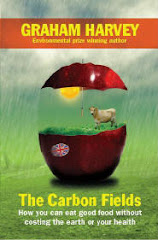
Last week I was involved in a radio 4 discussion in celebration of 100 years of the NFU, look here to read more. Whilst I was searching BBC archive for their 'listen again' to add to the blog I stumbled across an interview I did in 2006. Although the piece is a little old it is still very relevant. As we are discussing the depletion of minerals from our current fruit and vegetables, due to the change to intensive farming. The discussion that takes place between myself and Peter Kendall, the then Deputy President, now President of the NFU. If you would like to hear the discussion please click here. You'll find the link to the radio piece on the RHS of the page.
My book We Want Real Food has just been re-released. To grab a copy visit Amazon or visit your nearest bookshop.
Monday, 25 February 2008


Thursday, 21 February 2008
Our duty to the land
Those of us who produce and market local food – or, like me, simply enjoy consuming it – don’t need reminding that it’s often a healthier way to eat. Now at last it seems the government is finally catching up with the benefits.
Health minister Ben Bradshaw has told the Commons that patients in west country hospitals showed faster recovery rates when offered locally-produced meat, dairy products, fish and vegetables than those given the usual anonymous hospital food. The comments are based on findings in
According to Ben Bradshaw no less than 80 per cent of the food served in
Let’s hope other government departments take note of the findings. If fresh, local produce can improve the health of people in hospital, it can bring benefits to the wider community too. Institutions like hospitals, schools and prisons are only the starting point. What this obese and sickly nation needs is a totally new food system based on well-grown, nutrient-rich produce.
Sad to see that National Farmers’ Union president Peter Kendall is still pushing for an expansion of large-scale, commodity food. At the union’s AGM he spoke of
I agree with the NFU president that
Tuesday, 19 February 2008
Down to Earth
I was pleased to see my investigation of soil so skilfully set out in the March issue of Ecologist magazine. The material is mostly taken from my chapter on soil in We Want Real Food. The magazine has used it as part of an extended feature on how climate change and peak oil will impact on our food supply.
It’s good to know the importance of healthy soils to our lives and health is getting the recognition it deserves. In this age of record crop yields it’s easy to get the impression that it’s the chemists, plant breeders and GM technologists who feed us.
The truth is that, however smart our technologies, it’s the living community below ground that enables plants to grow. They supply plants with the nutrients they need, provide them with water and protect them against toxins and disease. Without the activity of soil life – from microscopic bacteria to earthworms – life above ground would quickly grind to a halt.

Sadly chemical farming subjects these living communities to a non-stop toxic barrage, wiping out whole species and disrupting the intricate subterranean network that keeps plants healthy. With their natural support systems weakened, crop plants become more dependent on pesticides to keep them growing – which is great for the chemical industry but bad news for the rest of us.
For the full story of why we owe so much to the life of the soil, take a look at Ecologist magazine. Alternatively, of course, you can read the book, We Want Real Food!
Saturday, 16 February 2008

Thursday, 14 February 2008
GM Scare Stories
Producers of GM seed have found a new way of sneaking out propaganda about their unpopular technology – they’re targeting business editors who aren’t normally too clued up on farming. How else can you explain a full page report in the world business section of The Times today warning of the possible collapse of
We’re told that shortages of grain for animal feed – together with high prices – are “wreaking havoc” on livestock production, causing pig and poultry farmers to cut back their output. According to the report the EU imports 80 per cent of its protein feeds mostly as GM soya and “corn”. It seems the main producing countries – the
To me the article looks like a classic piece of scare-mongering on behalf of the GM companies and global commodity traders. I checked with a couple of farming friends. They agreed that soya supplies were tight but said it had “naff-all” to do with GM approvals. It’s simply that rocketing Chinese demand for protein grains is putting a strain on supplies. While this may be disruptive, it’s hardly likely to lead to the destruction of civilisation as we know it.
For decades now the EU has produced vast surpluses of feed grains. It could easily substitute home-grown protein grains for the cheap American soya the livestock industry has now become addicted to. The
What’s wrong with turning over some of the land to producing our own protein feeds – traditional crops like beans and peas? These were the proteins British farmers put in their animal feeds before they acquired their
Maybe business editors should talk to farmers more often and rely less heavily on briefings from the GM industry.
[1] ‘
Monday, 11 February 2008
Climate change and agriculture.
As I discussed in an earlier post (7.2.08) 'The answer is blowing in the wind', farming is considered to be a factor in global warming. But climate change in turn is impacting on agriculture.

I talked about this topic last July in the Comment is Free website - Reaping what we've sown. Here is an extract from the article.

I talked about this topic last July in the Comment is Free website - Reaping what we've sown. Here is an extract from the article.
"It would be comforting to think that, in the brave new world of microprocessors and nano-technology, food production would be less vulnerable to such natural disasters. Unfortunately, the reverse is the case. If the recent floods and rainstorms prove anything, it's that at the start of the 21st century our food supplies remain worryingly insecure and precarious.
As far as the countryside is concerned the main accomplishment of the European Union - and its poisonous offspring, the common agricultural policy (CAP) - has been to increase massively the grain-growing area at the expense of grassland. Since we joined the EU in the early 1970s, Britain's wheat-growing area has doubled. Instead of grazing livestock on pasture, many cattle farmers concentrated their animals in sheds and fed them on the cheap, subsidised grain.
Compared with traditional pastoral farming systems, wheat-growing is highly unstable. It relies on energy-rich inputs of chemical fertilisers and sprays, many of them imported. It demands a decent spell of weather at harvest time if the crop is to be got in. And, even under favourable conditions, it depends on squadrons of diesel-burning monster machines to do the job."
Friday, 8 February 2008
Health or wealth?
After Hugh Fearnley-Whittingstall's and Jamie Oliver's spirited campaign on behalf of intensively-farmed chicken, Tesco's decision to sell a bird at less than £2 looks insensitive to say the least. Sadly it's all part of the supermarket culture that puts takings at the check-out ahead of respect for its customers.
 Today science is revealing that milk produced from cows on fast-growing spring pastures is high in fat-soluble vitamins, omega-3s and the cancer-fighting CLA, all the things that protect people from disease.
If you want to read more on this topic I wrote an article for the Guardian UK, Comment is Free website today. Click here to read more - A cheap trick.
"Supermarkets stock 50 different brands of instant coffee so there is something - so they claim - to suit all requirements. Tesco's £1.99 chicken sits alongside free range, organic and a host of other birds. It's called market fragmentation, or some such thing, and it allows the company to maximise its take at the checkout. It's also supposed to give consumers a greater choice.
In reality there's no choice at all. While the strategy may work for washing-up liquid or torch batteries - where the consumer can pretty well estimate what they're getting for their money - it's a nonsense when applied to food. Until science comes up with a way of measuring the total nutrient content of a food, there's no way the consumer can make a sensible choice."
 Today science is revealing that milk produced from cows on fast-growing spring pastures is high in fat-soluble vitamins, omega-3s and the cancer-fighting CLA, all the things that protect people from disease.
If you want to read more on this topic I wrote an article for the Guardian UK, Comment is Free website today. Click here to read more - A cheap trick.
"Supermarkets stock 50 different brands of instant coffee so there is something - so they claim - to suit all requirements. Tesco's £1.99 chicken sits alongside free range, organic and a host of other birds. It's called market fragmentation, or some such thing, and it allows the company to maximise its take at the checkout. It's also supposed to give consumers a greater choice.
In reality there's no choice at all. While the strategy may work for washing-up liquid or torch batteries - where the consumer can pretty well estimate what they're getting for their money - it's a nonsense when applied to food. Until science comes up with a way of measuring the total nutrient content of a food, there's no way the consumer can make a sensible choice."
Subscribe to:
Posts (Atom)